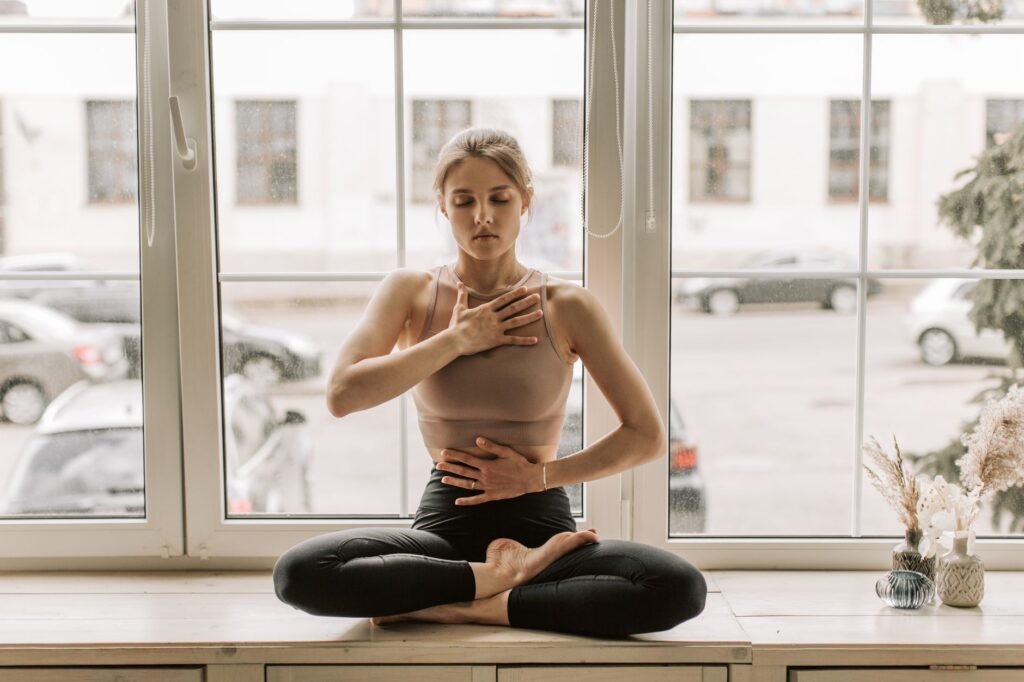
You know that feeling when anxiety creeps in and you suddenly notice you’ve been hunched over your phone for the last hour, shoulders up near your ears, breathing shallow and fast? That’s not a coincidence. And it’s not just “in your head,” either. Your body has been quietly shaping your mental state this whole time — and most of us never learned to pay attention to it.
We tend to think of anxiety as something that starts in the mind: a worried thought, a spiral, a “what if.” So we try to fix it with more thinking — reasoning our way out, journaling, analyzing. All useful tools. But there’s a much older, much faster system running underneath all of that: your posture and your breath. And it might be quietly working against you.
Your body talks to your brain before your brain talks back
Here’s the part that surprises people: the relationship between your body and your emotions isn’t one-directional. We usually assume feelings cause physical states — you’re anxious, so you tense up. But it also works the other way around. Slouched, collapsed posture and shallow chest breathing can actually generate feelings of anxiety, low mood, and helplessness, even when nothing “bad” has happened yet.
Researchers call this idea embodied cognition — the notion that your physical state is part of your emotional state, not just a symptom of it. Studies on posture have found that sitting in a slumped position, compared to sitting upright, leads people to report more negative emotions, lower energy, and even lower self-esteem after a stressful task. Your nervous system reads your body’s signals as data. Curled-in, tight, guarded posture tells your brain: something is wrong, stay small, stay alert. It’s a feedback loop, not a one-way street.
Why your breath is the fastest lever you have
Breathing is unique among all your bodily functions because it’s both automatic and voluntary. You don’t have to think about breathing to survive, but you can take control of it whenever you want. That makes it one of the few direct dials you have on your autonomic nervous system — the part of you that decides, without asking permission, whether you’re in “safe and calm” mode or “threat and alert” mode.

When anxiety shows up, breathing tends to move up into the chest and speed up, becoming short and shallow. This isn’t random — it’s the same pattern your body uses when you’re actually in danger, because rapid, shallow breathing prepares you to react fast. The problem is that your body can’t always tell the difference between a real threat and an inbox full of unread emails. So it reacts as if you need to run, even while you’re sitting at your desk.
Slow, deep breathing does the opposite. It signals to your vagus nerve — a key highway between your body and your brain — that you’re safe. This activates your parasympathetic nervous system, the “rest and digest” state, which lowers heart rate and helps your mind settle. It’s not a metaphor; it’s measurable physiology. And it usually takes less than two minutes to notice a shift.
The posture-breath connection nobody mentions
Here’s where it gets interesting: posture and breathing aren’t separate habits, they’re deeply linked. When you slouch — shoulders rounded, chest caved, chin dropping toward your phone — you physically compress your diaphragm and ribcage. There’s simply less room for your lungs to expand. So bad posture doesn’t just look defeated; it mechanically forces you into the same shallow, anxious breathing pattern your body uses under stress.
That means fixing one without the other is only half the work. You could do all the breathing exercises in the world, but if you’re folded over a laptop for eight hours a day, your body is fighting you the whole time.
Small, doable shifts — not a posture overhaul
This isn’t about sitting ramrod straight all day or turning into someone who does yoga at dawn. That’s not sustainable, and it’s not the point. The point is noticing, a few times a day, and making small corrections that add up.
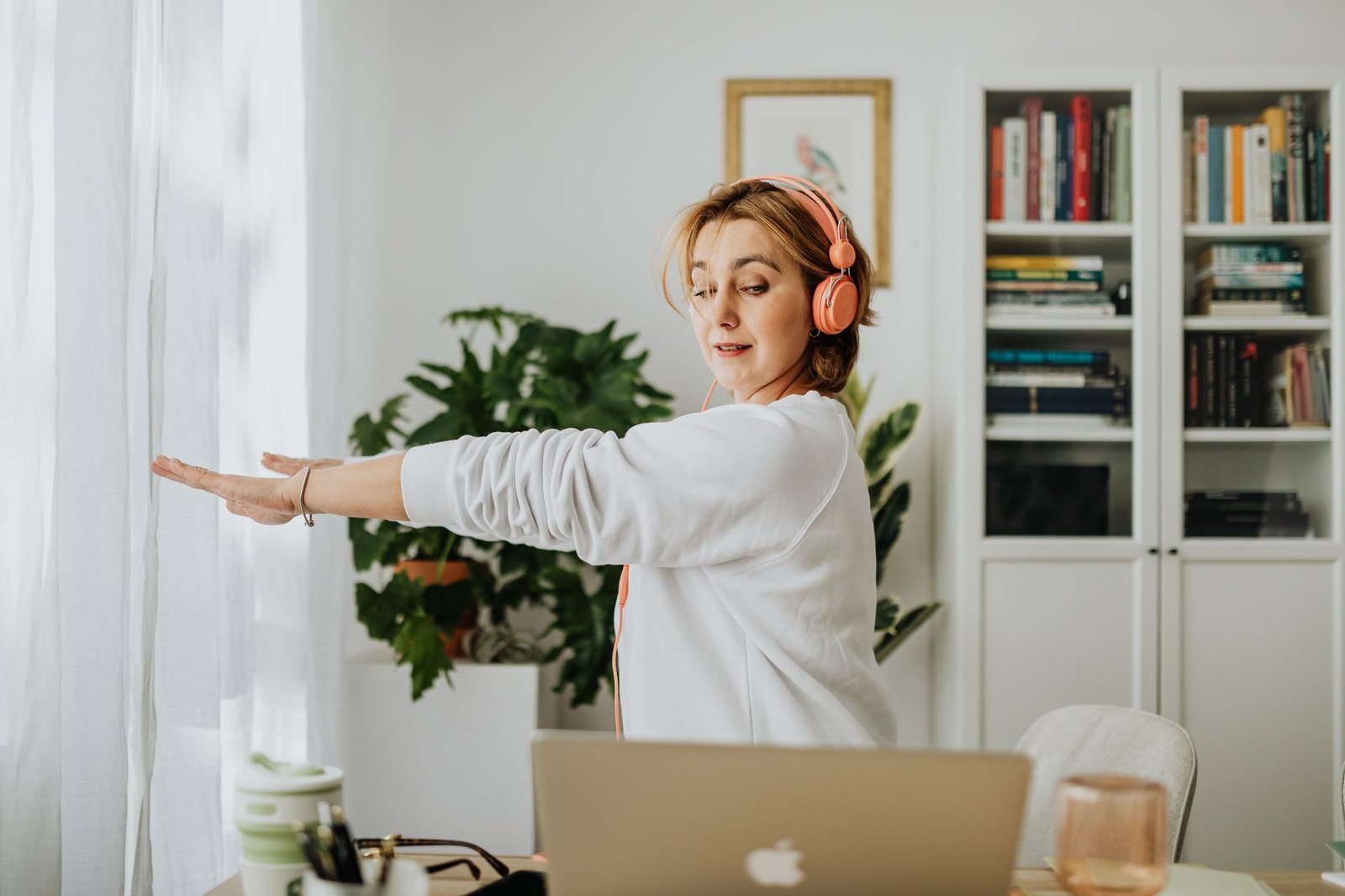
- Unclench and drop your shoulders. Roll them back and down, away from your ears. Notice how much tension you were holding without realizing it.
- Lengthen through the crown of your head. Imagine a string gently pulling the top of your head upward — not stiff, just lifted. This alone opens up space for your lungs.
- Try the exhale-longer trick. Breathe in for a count of four, out for a count of six or eight. A longer exhale is one of the fastest ways to cue your nervous system to calm down.
- Set a body check-in reminder. Twice a day, pause and ask: where am I holding tension right now? Jaw, shoulders, chest? You don’t need to fix it, just notice it.
- Move before you sit for hours. Even 60 seconds of stretching your arms overhead and opening your chest can reset the pattern before it locks in.
This won’t erase anxiety — and that’s okay
None of this replaces therapy, medication, or the deeper work of understanding why you feel anxious in the first place. Posture and breath aren’t a cure. But they are a genuinely underused lever — something you can access in the middle of a hard moment, without needing anyone’s permission or a perfect set of circumstances.
What’s powerful about this mind-body link is that it gives you back a sense of agency. Anxiety can feel like something happening to you, something you can’t control. But your breath and your posture are always available, always yours, always responsive. You don’t have to wait to feel calm before you sit up or slow your exhale — you can do it first, and let the calm follow.
Next time anxiety creeps up, before you try to think your way out of it, try this instead: unclench your shoulders, lengthen your spine just a little, and slow your exhale. It’s a small thing. But your body has been listening this whole time — it might be ready to listen to something calmer, too.
[…] Posture, Breathing, and Anxiety: The Mind-Body Link […]